Complex stormwater management systems that satisfy state and local requirements on the first submittal — from detention ponds to water quality BMPs.
Stormwater management is among the most complex and consequential aspects of land development in the Southeast. Poor stormwater design has three direct consequences: permit rejections that delay projects, costly redesigns after plan review, and long-term liability to developers for inadequate flood protection or water quality.
Southeast development faces unique stormwater challenges. High rainfall intensities, complex soil conditions, and stringent state water quality standards (NCDEQ, SCDHEC, GAEPD) mean stormwater systems must be properly sized, hydrologically sound, and capable of functioning during the most severe weather events anticipated over project lifetime.
Improperly designed detention ponds, undersized water quality treatment, and inadequate drainage calculations are among the most common reasons land development permits receive deficiency notices. These rework cycles delay project schedules by months and add tens of thousands of dollars in design fees and professional services.
Hagen Engineering approaches stormwater management as an integrated system. Rather than designing detention ponds in isolation from site grading or water quality treatment separate from drainage calculations, our team develops stormwater strategies that work holistically — using site topography to drive gravity flow, sizing ponds to actual storm event frequencies, and selecting BMPs that achieve water quality requirements for your specific site context.
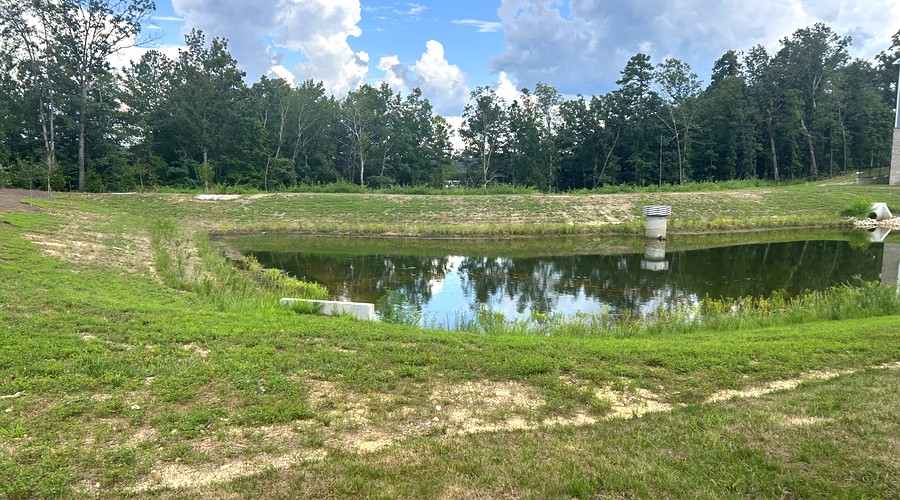
Understanding the distinction between detention, retention, and water quality treatment is fundamental to proper stormwater design. Each serves a distinct function and requires different design approaches.
Detention systems temporarily store stormwater runoff during rain events, releasing it gradually downstream — slowing peak flows to reduce downstream flooding and allow sediment to settle. Detention ponds are designed for a specific storm frequency (typically the 10-year or 25-year rain event). Sizing detention requires hydrologic routing calculations based on site impervious area, rainfall intensity-duration curves, and outlet structure design.
Retention systems permanently store stormwater — either infiltrating it into groundwater or storing it for non-potable reuse. Retention requires groundwater evaluation and soil permeability testing to ensure safe infiltration. Oversized infiltration systems fail; undersized systems become nuisance ponds requiring perpetual maintenance.
Water quality treatment removes pollutants from stormwater before it reaches receiving waters. Common BMPs include bioretention gardens, rain gardens, hydrodynamic separators, and proprietary treatment devices. Each BMP type has specific design requirements, maintenance needs, and pollutant removal capabilities. Selecting the right BMP for your site's soil conditions, available space, and treatment objectives is critical to achieving water quality compliance.
Hagen's approach integrates all three. We design detention to meet quantity requirements, specify BMPs that achieve water quality standards, and explore infiltration opportunities where hydrogeology permits. The result is a stormwater system that passes agency review and functions reliably throughout project life.
Each Southeast state maintains distinct stormwater design manuals and water quality standards. NCDEQ's stormwater manual differs from SCDHEC's requirements, which differ from GAEPD, TDEC, or other state standards. Designers unfamiliar with state-specific guidance often specify designs that conflict with local reviewing authority expectations — resulting in comment letters and redesign.
North Carolina requires detention for the 25-year, 24-hour storm and water quality treatment for the 1-year storm. South Carolina follows a similar framework but with different hydrologic calculation methods. Georgia emphasizes infiltration over detention in appropriate soils. Tennessee and Virginia have their own unique requirements.
Beyond state manuals, individual municipalities often adopt stricter standards. Some jurisdictions require greater detention volumes, mandate specific BMP types, or restrict detention pond locations. Hagen's team maintains current knowledge of state manuals and local ordinances throughout the Southeast, ensuring designs that comply on the first submission.
We coordinate directly with NCDEQ, SCDHEC, and other reviewing agencies during pre-application meetings to confirm our design approach before committing resources to detailed calculations. This proactive coordination prevents costly rework and accelerates the permit approval process.
Detention ponds are the cornerstone of stormwater quantity management for most land development projects. Proper detention design requires accurate hydrologic calculations, thoughtful outlet structure design, and consideration of downstream channel capacity and infrastructure.
We perform hydrologic routing using HEC-HMS or equivalent software, modeling rainfall events of specified frequency and calculating runoff volumes that must be detained. Routing calculations account for site topography, soil infiltration, and seasonal groundwater conditions to determine peak discharge rates and required detention volumes.
Outlet structure design is critical — undersized outlets create excessive surcharge and inundation; oversized outlets defeat detention purpose. We design outlet structures with orifices, weirs, or stage-discharge relationships that release stored water at rates that do not exceed downstream channel capacity.
Pond geometry balances storage volume, surface area, side slopes, and maintenance access. Shallow ponds with gentle slopes are easier to maintain but require more land. Steeper sides reduce footprint but complicate maintenance and increase slope stability concerns. We design pond geometry appropriate to available land and long-term maintenance feasibility.
All detention ponds include sediment forebays to trap incoming sediment before it deposits throughout the pond, extending pond life and maintaining treatment performance. We design forebays with proper scour velocity and cleanout procedures for contractor implementation.
Water quality BMPs remove pollutants (sediment, nutrients, hydrocarbons, metals) from stormwater. Selecting the appropriate BMP requires evaluation of site conditions, treatment objectives, maintenance feasibility, and regulatory acceptance.
Bioretention gardens are vegetated systems where stormwater is filtered through engineered soil media, removing pollutants through settling, infiltration, and plant uptake. Rain gardens are a simpler variant suitable for smaller drainage areas. Both require adequate space and appropriate soil permeability.
Stormwater wetlands provide treatment through settling and biological processes in a planted water environment. Wetland design requires careful consideration of water depth, vegetation selection, and inlet/outlet structure to maintain proper water levels and prevent short-circuiting.
Proprietary water quality devices (hydrodynamic separators, cartridge filters, proprietary infiltration systems) offer compact treatment for space-constrained sites. Each device has specific maintenance requirements, replacement intervals, and treatment certifications that must be evaluated during design selection.
We select BMPs based on site-specific conditions and project context. For space-constrained projects, we specify compact proprietary devices. For projects with available land and appropriate soils, we design infiltration-focused BMPs that reduce downstream runoff volume. The result is a water quality approach tailored to your project's constraints and objectives.
Many development sites require drainage studies to evaluate existing site hydrology, off-site watershed characteristics, and receiving stream capacity. These studies determine site suitability for development and inform stormwater detention sizing.
We conduct hydrologic studies using USGS data, historical rain records, and GIS analysis to characterize watershed conditions and existing runoff regimes. Field surveys confirm soil types, infiltration characteristics, and topographic flow patterns that affect stormwater behavior.
For sites with significant off-site drainage, we evaluate upstream watershed areas and existing drainage patterns to ensure site stormwater management does not exacerbate downstream flooding. This analysis often reveals opportunities to improve existing off-site conditions through thoughtful project design.
Floodplain analysis evaluates whether proposed development lies within mapped flood zones and what impact development may have on existing flood patterns. For projects in or adjacent to floodplains, we coordinate with FEMA and local floodplain administrators to confirm that site development does not adversely impact community flood risk.
These studies often become required submittals for permitting, making their completion early in the design process critical to schedule maintenance and avoiding redesign after preliminary design review.
Let our stormwater specialists evaluate your site and develop a management strategy that passes agency review on the first submittal.