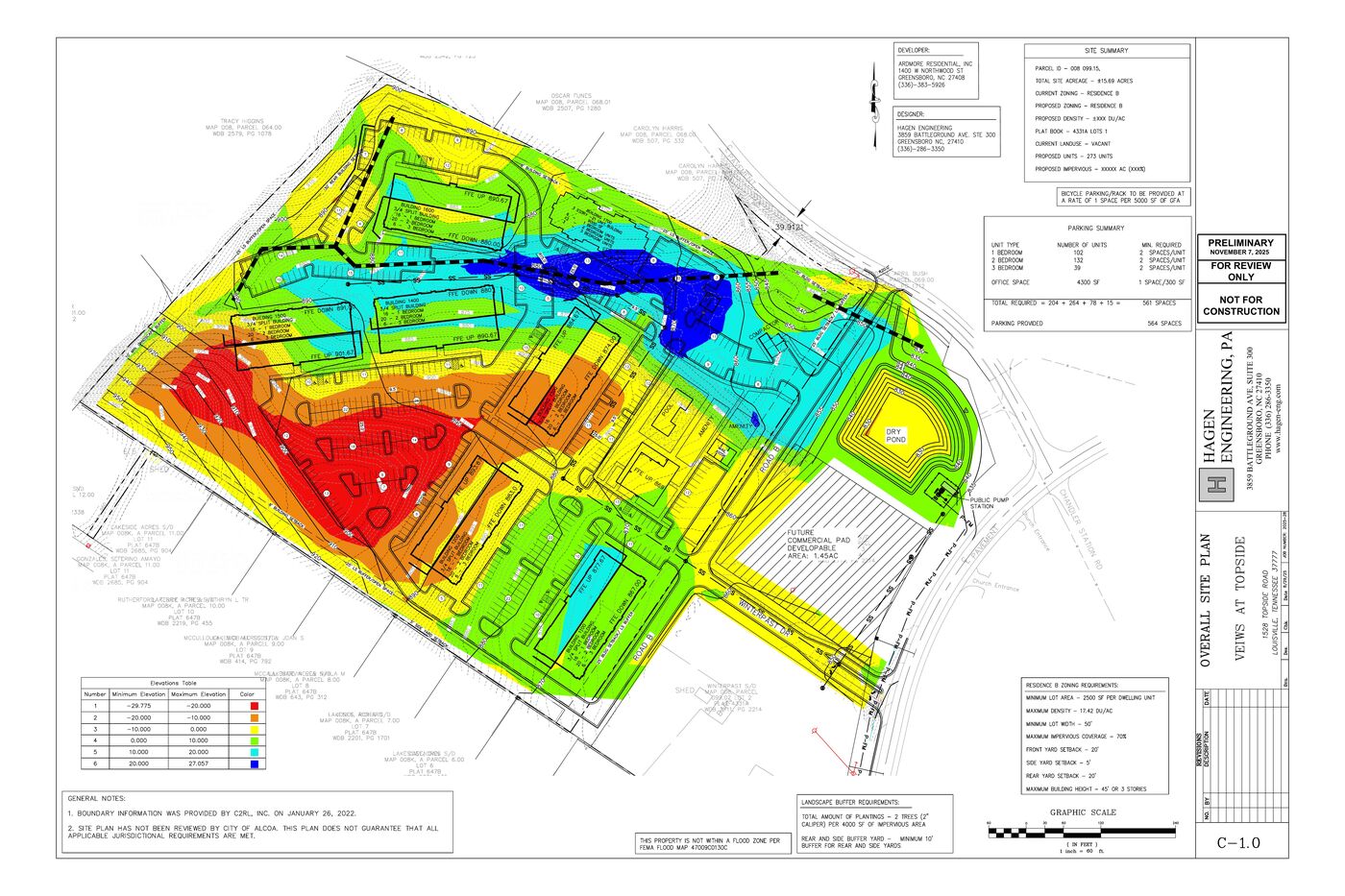
Accurate earthwork quantification drives cost control in land development. From initial feasibility through final grading plans, our analysis ensures your project's earthwork is balanced, optimized, and buildable.
Earthwork is frequently the single largest variable cost on a land development project. For a typical multifamily or commercial development, earthwork can represent 8-15% of total hard costs — and that's when the site is reasonably balanced. When a site requires significant import or export of material, earthwork costs can skyrocket and jeopardize project feasibility.
The difference between a balanced site and an unbalanced one can mean hundreds of thousands of dollars in hauling costs. A 50-acre commercial development requiring 100,000 cubic yards of fill import might incur $600,000 to $1,000,000 in additional material and hauling charges. Conversely, a site with surplus material requiring export may face landfill tipping fees of $10-20 per cubic yard or higher, depending on regional waste management costs and material suitability.
Import and export of material dramatically affects project budgets, construction schedules, and pro-forma accuracy. Every cubic yard hauled off-site represents wasted profit potential; every cubic yard imported adds hard costs that should have been eliminated through smarter design. This is why grading optimization before final design is not optional — it's essential to project financial viability.
Hagen Engineering approaches grading analysis as an integral part of site and civil design, not an afterthought. Early-stage earthwork analysis during feasibility and master plan phases allows us to evaluate alternative grading scenarios, adjust finished floor elevations, modify road profiles, and reconfigure stormwater and infrastructure layouts to achieve maximum earthwork balance. This discipline-coordinated approach to design ensures the lowest achievable earthwork costs while maintaining all required drainage, utility, and access functions.
For developers making acquisition decisions, accurate earthwork quantification is critical to evaluating site suitability. A site that appears feasible in preliminary analysis may prove unfeasible if earthwork costs are underestimated. Our detailed takeoff analysis provides the quantitative foundation for confident acquisition and financing decisions.
Consider a typical scenario: a 20-acre infill mixed-use development in an urban setting with existing utilities, constrained site boundaries, and complex topography. Initial grading plans show a deficit of 40,000 cubic yards (material needed to build pad elevations and parking). At an average import cost of $12-18 per cubic yard (including material, hauling, and placement), that deficit translates to $480,000 to $720,000 in earthwork cost — before site development even begins.
By adjusting building pad elevations by 2-3 feet, modifying parking slopes, and reconfiguring the stormwater detention area, Hagen's analysis identifies a revised grading design that achieves 95% balance — importing only 2,000 cubic yards (roughly $24,000 to $36,000). That single optimization saves $440,000 to $690,000 in hard costs and can be the difference between a profitable project and one that fails financing approval.
Hagen's earthwork analysis is systematic, disciplined, and grounded in industry-standard civil engineering software and methodology. Here's how we approach earthwork quantification for your project:
Every accurate earthwork calculation begins with precise existing site topography. We integrate detailed survey data (topo maps with 1-2 foot contour intervals) into our design platform and evaluate all site constraints: existing utilities, structures, protected areas, easements, and natural features. We coordinate with site surveyors and geotechnical engineers to ensure we're working from current, accurate baseline data.
Earthwork doesn't exist in isolation. All grading must coordinate with site drainage, utility routing, road and parking design, building pad requirements, and stormwater management. We develop proposed grading in parallel with these systems, not as a separate exercise. This integrated approach ensures feasible construction while optimizing cut and fill balance.
We use professional civil design software (Civil 3D, InRoads, or equivalent) to model existing conditions surface and proposed conditions surface. The difference between these surfaces is then analyzed to calculate precise cut and fill volumes throughout the site. These calculations account for all design features: building pads, parking areas, roads, sidewalks, utilities, swales, ponds, and landscape slopes.
Raw volume calculations don't tell the full story. Earthwork material changes volume when disturbed and recompacted. Fill material typically exhibits a shrinkage factor of 10-20%, meaning 100 cubic yards of bank material compacts to 80-90 cubic yards in place. Different soil types (sandy soils, clays, rocky material) shrink at different rates. We apply appropriate shrinkage factors based on geotechnical site characterization and local experience to generate accurate import/export quantities that contractors and cost estimators can rely on.
Mass haul analysis identifies where cut material is generated and where fill is required, then calculates the optimal distance material must travel. A mass haul diagram is a graphical analysis tool that shows cumulative cut and fill volumes along a project corridor (or across a site plan). It identifies the most economical points to balance cut and fill and minimizes the total hauling distance. This analysis is particularly valuable for linear projects (roads, corridors) and large-scale developments with variable topography.
Topsoil and unsuitable surface material must be stripped, managed, and reused or disposed. We calculate stripping volumes separately and identify stockpile areas for temporary material storage during construction. For developments where topsoil reuse is required by environmental standards or design intent, we quantify the tonnage available and plan for proper segregation and redistribution.
Structural design of pavements and building pads requires stable, suitable subgrade material. Through coordination with geotechnical investigations, we identify zones where native material is unsuitable (excessive clay, rock, contamination, poor bearing capacity) and must be excavated and replaced with suitable structural fill. These unsuitable material projections become line items in earthwork cost estimates and project schedules.
Our earthwork analysis incorporates findings from geotechnical boring logs and soil investigations. We identify material suitability zones, note areas with rock or unstable soil, and flag potential groundwater constraints that affect excavation and fill placement. This coordination ensures earthwork quantities reflect real site conditions, not assumptions.
What sets Hagen's approach apart is our commitment to grading design optimization as a core objective, not an afterthought. Many firms design site grades in response to other constraints (drainage, utilities, building requirements) and accept whatever earthwork costs result. We flip that perspective: we design with earthwork economy as a central design driver.
Early in the design process, we develop multiple grading scenarios — Scenario A with a certain building pad elevation and road profile, Scenario B with adjusted elevations, Scenario C with modified stormwater configuration. We calculate earthwork quantities for each scenario and present the cost implications. This process typically identifies a grading design that achieves 85-95% balance — far superior to unrefinement designs.
Cut and fill balance is achieved by strategic adjustment of design elevations. Higher building pad elevations create more fill demand; lower pads create more cut material. Road profiles can be flattened or steepened to consume or minimize cut material. Parking areas can slope in different directions to redirect drainage and manage fills. Stormwater pond elevations can be raised or lowered to utilize excavation material.
A skilled earthwork engineer understands how each design decision ripples across the site's earthwork balance. We identify the most cost-effective elevation adjustments (for example, raising a building pad 1.5 feet might eliminate 30,000 cubic yards of import cost) and coordinate these changes across all site systems.
Stormwater detention ponds can be powerful earthwork tools. Excavation of a pond generates fill material; that material can be used to build surrounding berms, pad elevations, or parking areas. Pond bottom elevation, side slopes, and embankment geometry should be designed with earthwork balance in mind. A well-designed pond system can convert fill deficits into manageable quantities.
Not all material is suitable for building foundations or pavement subgrades. We coordinate with structural engineers to identify where imported structural fill is required (engineered, compacted material meeting specific geotechnical standards) versus where general fill (stripped surface material, lower-quality cut material) is acceptable. This distinction affects costs: structural fill specifications are expensive; general fill is cheap. Smart material planning minimizes structural fill quantities while ensuring structural requirements are met.
Many developers are surprised during construction when excavation volumes don't match takeoff quantities. This discrepancy typically results from failure to account for shrinkage. We apply documented shrinkage factors (usually 10-20%, depending on soil type) in all calculations. When 100,000 cubic yards of bank-measure material is excavated, it becomes only 85,000-90,000 cubic yards of compacted fill. This matters enormously when cost estimating and procurement planning.
Hagen's earthwork analysis experience spans the full spectrum of Southeast land development:
Regardless of project type or complexity, our earthwork analysis follows the same disciplined process and applies the same optimization mindset to your project's specific requirements and constraints.
Hagen's earthwork analysis produces specific, actionable deliverables that support design, construction, and project financing:
These deliverables are integrated into our site and civil engineering documents — grading plans, site plans, and construction specifications — and are designed to be directly usable by contractors, cost estimators, and project managers during construction.
Hagen has engineered grading and earthwork for more than 15,000 apartment units and 3,000+ single-family residential lots across the Southeast. That experience translates directly to confident earthwork analysis and optimization for your project.
Our service territory spans 8 states with dramatically different soil conditions and topography. Piedmont clay soils in the Carolinas behave differently from sandy soils in the coastal plain; mountain topography in Tennessee and Georgia creates unique grading challenges; alluvial soils along river corridors present different geotechnical characteristics. Our regional experience means we understand not just the engineering principles of earthwork analysis but the practical reality of how different soils and geographies affect actual cost and constructability.
We've helped dozens of developers evaluate site acquisition decisions based on earthwork feasibility. We've identified grading optimization strategies that saved projects hundreds of thousands of dollars in hard costs. We've worked with contractors to sequence earthwork construction across multiple phases, managing material movement and stockpiling to maintain efficient construction flow. We've coordinated complex earthwork on constrained infill sites where every cubic yard of material movement required careful planning and environmental review.
Most importantly, our earthwork analysis integrates seamlessly with our full suite of civil engineering services. Grading design doesn't exist in isolation from stormwater, utilities, and site layout — and our team approach ensures all these systems are optimized together. When you engage Hagen for earthwork analysis, you're getting engineers who understand how grading decisions affect drainage, utilities, construction cost, and schedule. That integrated perspective delivers genuine cost savings and project success.
Let Hagen Engineering's analysis and design expertise help you achieve maximum earthwork balance and cost efficiency. Accurate takeoffs, smart grading design, and thoughtful material planning start with disciplined engineering — that's what we deliver.